The Burning Stage - #1 Out of the Shadows
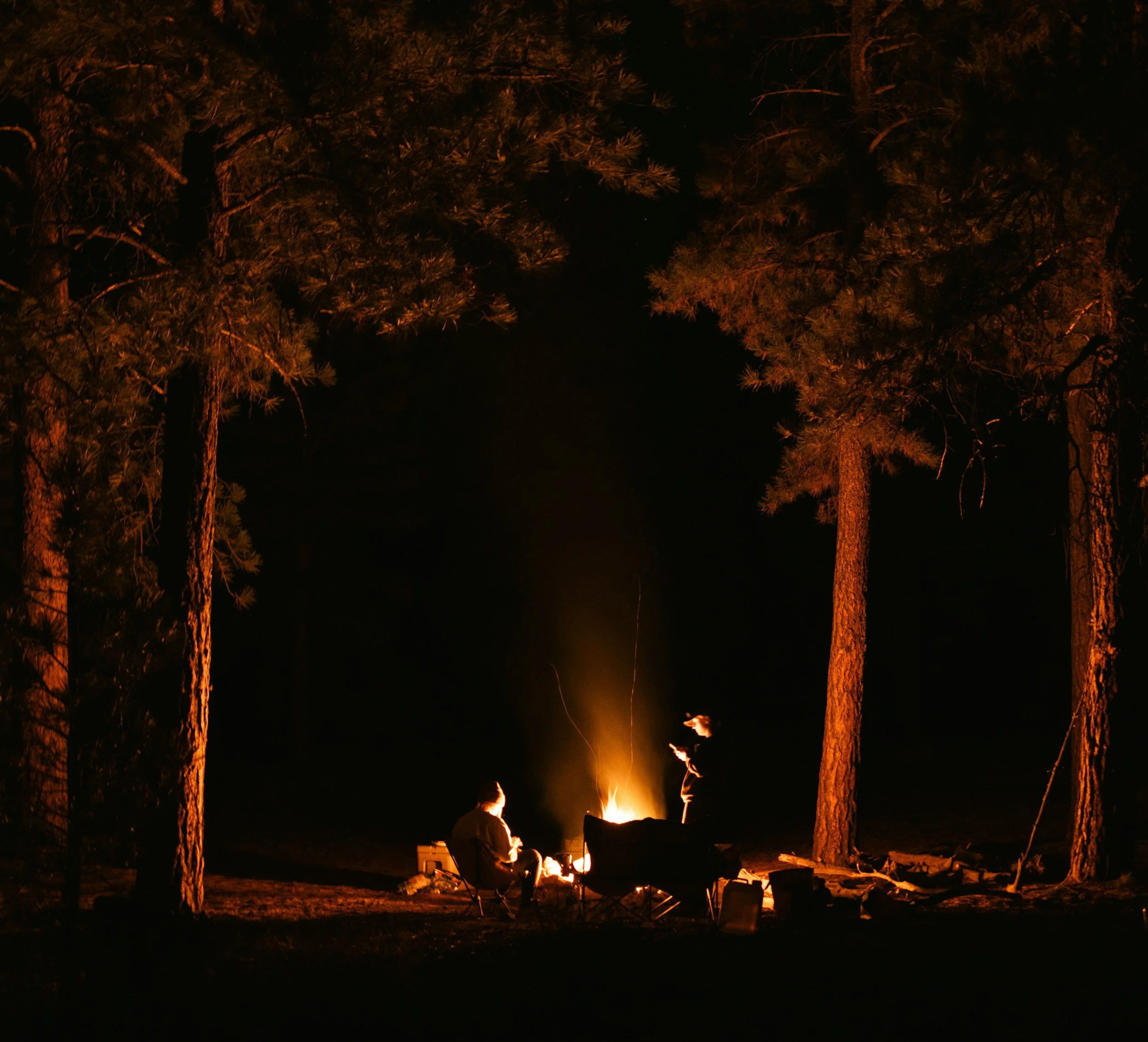
Imagine, if you will, that you find yourself in the middle of a dark forest. The trees gather round you and their branches sweep overhead, closing you in. What you can see of the sky is darker still and you can see no stars in the blackness. You are alone and cold. But in the distance, you see a faint glow of reddish light. As you stumble forward you find yourself in a clearing in the centre of which a fire burns brightly. People are gathered round, enjoying the warmth and companionship. You sit yourself in the circle and watch the fire burning. You notice how, at the heart it shines with brilliant intensity, the filmy blue fire consuming the resiny vapours given off by the logs. Further from the centre of the blaze, red and orange flames dance, giving out the warmth and the glow that reflects in the faces of those watching. And, at the margins, hot coals give a comforting warmth that exists long after the fire itself has died away. Behind us, the shadows watch from the trees.
Now imagine a theatre performance. At its centre, the actors are alive with intense energy, projecting their interactions with each other outwards to engage an audience who are drawn forward by the humanity of what they are seeing. We are together in one space. All are experiencing the real warmth of human contact, actor to audience and audience to actor. Our combined imaginations produce one drama.
What I am trying to describe here is an entirely human experience, stripped of anything but the actor and the audience.
When I work with actors, I like to work in small, human scale places with the audience as close to the actors as possible. I try to do away with anything that does not belong to this experience. I try to include only the barest minimum of lighting, music, complicated sets and effects.
This stripped back, unplugged, intense form of performance I call The Burning Stage.
This is not a prescription or a set of rules. It does not denigrate any other performance or style of performance. Every performance and style is valid and will work for some but not others. I merely offer this as a collection of thoughts for anyone who may find themselves bogged down in the minutiae of theatre making or who find some current work unsatisfying and distant. And, of course…
…thousands of theatre companies, large and small, throughout the world have always worked this way. And, for many of them, they go about their task without receiving the full recognition they deserve.
I love all forms of theatre and performance and admire everyone who plunges into any form of it but this is how I’ve worked over the last fifty or so years and is, in the end, how I like to work with actors and audiences. That’s all.
The Burning Stage finds its roots in Artaud’s Theatre of Cruelty and Grotowski’s Poor Theatre. It is a description of a form of theatre that is both ancient and starkly modern. It seeks to be both universal and intensely personal. It eschews spectacle in favour of the humane.
Perhaps it can be distilled thus:
Immersive Experience: The Burning Stage aims to create a truly immersive experience for both the audience and the actors. It challenges the actors to commit fully to the limited space they share with the audience, fostering a deeper connection. Here the experience is focused and committed. Both bring their concentration and attention to this moment. The stage becomes a holy place and is treated with respect by both participant groups.
Triangle of Responsibility: In The Burning Stage, the responsibility for the performance is shared equally among the writer, actor, and audience. This creates a social ritual where each performance is a unique and collaborative event.
Raw and Unfiltered: The style emphasizes raw, unfiltered performances that strip away traditional theatrical conventions, focusing on the raw energy and emotion of the actors.
A State of Mind
To sum it up in another way: The Burning Stage is an attitude or a mindset. It does not require special training or experience. Beware anyone who tries to teach it to you. It will be something you puzzle out for yourself with the particular actors and audience you are working with. It does, however, require commitment from all parties involved. And the suggestions I make here are ways in which I try to generate these attitudes with the actors and draw in audiences many of whom will have been excluded by the weird formality that we love to generate in the theatre. These arcane behavious might provide us, the actors, with warmth and security but can we say that the audience feels the same? Perhaps our weird slang and superstitions can alienate others.
More fundamentally, theatre is expensive these days. Productions cost huge amounts to stage and often rely on star names. Ticket prices are, accordingly, out of reach of many audience members and prevent a theatre going habit forming. Theatre becomes an occasional treat. Part of the reason for this, I guess, is because traditional theatres see themselves in competition with films and video games. They are creating extravagant spectacles and star vehicles.
Maybe, our unplugged approach will enable more people to get involved either as theatre makers or audiences. By doing away with the need to pursue bigger and better special effects we can concentrate on the golden USP of theatre – imagination.
The unplugged approach also releases us from the movie conventions that force the attention of the audience to experience pre-set emotions by the use of music or mood lighting. Movies insist that the audience looks at this thing or follows that scene through the lens of a camera. At the Burning Stage, audiences are freed of the constraints imposed by the film editor or director. Their emotional response is directly related to the emotional intensity of the Drama. It is not emotionally manufactured or imposed. And if the audience finds the tragedy funny or the humour sad, that is a genuine, unforced response. So be it.
The Burning Stage is thus a way of finding an alternative to the Theatre as Spectacle. Spectacle aims to rival movies and on-line gaming platforms. In those terms it can’t rival Spectacle. But it doesn’t need to. Or it shouldn’t. There is room for spectacle, of course, but the heart and soul of Theatre and Drama is somewhere else. It is human and about humanity.
The Burning Stage holds no particular allegiance or set of beliefs. It can challenge and explore issues. But, above all, it is an experience that brings people together as individuals and tells us something about that experience.
“My approach is designed to challenge both performers and audiences, pushing the boundaries of traditional theatre to create a more engaging and dynamic experience.”
I want to use the Burning Stage to explore the humanity that underlines our place here in the cosmos. Beyond the issues and temporal vicissitudes of life to something deeper and, perhaps, richer.
Why I think this important
…but don’t bother to read this if you’re not interested in what I think.
Here I’ll try to outline my reasons for not wanting to involve myself in the world of spectacle. Not that I decry chariot races and football matches or Grand Opera. They all have their place and I love them all. (Although I’ve never been fortunate enough to attend a chariot race). These inhabit a different part of the psyche from that of The Burning Stage and, in many ways, they illustrate a fundamental disjunction in all our lives today. The world is increasingly being made as a Spectacle. We become mere onlookers. We watch on, fascinated and appalled, by a world that is ever more complex, grandiose and out of touch with our day to day existence. We are alienated and made to feel diminished. Everything from entertainment to politics, to our very aspirations, are distant and alienated. Even worse, we are distracted by the wonder and awe of it all and made to feel worthless and unable to join in as we once might have done. As Margaret Thatcher said: “There is no such thing as society.” And, indeed, what once were unifying social mechanisms have crumbled or have become the property of others.
The French philosopher Guy Debord summed it all up in his book ‘The Society of the Spectacle.’
"All that once was directly lived has become mere representation."
So the view we have of our world is largely mediated by the Men of Power. And as we are denied agency we become more and more anxious. Adrenaline flows because of the sheer repeated buffeting of the spectacle we witness and are powerless to influence. The adrenaline goes to make our hearts race and our bodies go into overdrive but there is no outlets for our emotion. We watch hypnotised by it all. Could this be why so many of us turn to running or strenuous gymn session? Just to work off our frustration? At the same time we try to validate our own existence through creative activites such as writing poetry or crochet. Secret inward desires and ambitions that are often framed by someone elses rules.
We avoid real human contact because we are secretly afraid of what others are thinking. We are led to believe that the world is inhabitated only by knife wielding maniacs. At any moment, something we say or do may trigger a snarling angry rebuff. We hunker down with our mental doors locked against others in a gross manifestation of the world according to Ayn Rand.
According to recent thinking, people lose their identires outside the workplace and the fight for money and a generation sits silent at home with nothing to define themselves. We do not have sufficient shared experiences to provide a common ground where a relationship may flourish.
Mark Fisher described this in ‘Capitalist Realism’:
“Capitalist realism as I understand it... is more like a pervasive atmosphere, conditioning not only the production of culture but also the regulation of work and education, and acting as a kind of invisible barrier constraining thought and action.”
In a great Irony, aspiring artists may even pay large corporations for a platform to express their thoughts as they seek the validation they are told they need. But these corporations are the very ones that are at the root of the Spectacle. The rules of expression are confined by their algorithms or artificial genres. The aim of these corporations is create more and more wealth so they make the algorithms increasingly more alluring. We plunder ourselves so that they may grow rich. We all buy into the very thing that crushes us.
For me, the answer to Spectacle is not a retreat into an individual expression fenced in by what The Spectacle decrees as worthwhile, but into mutual cooperative action. There are many ways of achieving this but I strongly believe that the Burning Stage is a place where we can begin to feel some form of fellowship.
Let’s see how this may work…